
| Country / Region | Recommended App | Suggested Payment Method | Recommended Route |
|---|
| 🇺🇸 United States | Coinbase / Kraken | ACH / Bank Transfer / Debit Card | USD → Crypto → USDT |
| 🇨🇦 Canada | Kraken / Coinbase | Interac / Bank Transfer | CAD → Crypto → USDT |
| 🇬🇧 United Kingdom | Kraken / Coinbase | Faster Payments / Bank Transfer / Card | GBP → USDT |
| 🇩🇪 Germany | Kraken / Coinbase | SEPA / Bank Transfer | EUR → USDT |
| 🇫🇷 France | Kraken / Coinbase | SEPA / Bank Transfer | EUR → USDT |
| 🇮🇹 Italy | Binance / Kraken | SEPA / Bank Transfer | EUR → USDT |
| 🇪🇸 Spain | Binance / Kraken | SEPA / Bank Transfer | EUR → USDT |
| 🇳🇱 Netherlands | Kraken / Coinbase | SEPA / Bank Transfer | EUR → USDT |
| 🇦🇺 Australia | Binance / Kraken | PayID / Bank Transfer | AUD → USDT |
| 🇳🇿 New Zealand | Binance / Kraken | Bank Transfer | NZD → USDT |
| 🇦🇪 UAE | Binance / HTX | Bank Transfer / P2P | AED → USDT |
| 🇸🇦 Saudi Arabia | Binance / HTX | Local Bank Transfer / P2P | SAR → USDT |
| 🇲🇾 Malaysia | Binance / HTX | DuitNow / Bank Transfer / P2P | MYR → USDT |
| 🇹🇭 Thailand | Binance / HTX | PromptPay / Bank Transfer / P2P | THB → USDT |
| 🇵🇭 Philippines | Binance / HTX* | GCash / Maya / Bank Transfer | PHP → USDT |
| 🇮🇩 Indonesia | Binance / HTX | Local Bank Transfer | IDR → USDT |
| 🇻🇳 Vietnam | Binance / HTX | Local Bank Transfer / P2P | VND → USDT |
| 🇮🇳 India | Binance / HTX | UPI / IMPS / Bank Transfer | INR → USDT |
| 🇵🇰 Pakistan | Binance / HTX | Easypaisa / JazzCash / Bank | PKR → USDT |
| 🇧🇷 Brazil | Binance / HTX | PIX / Bank Transfer | BRL → USDT |
| 🇲🇽 Mexico | Binance / HTX | SPEI / Bank Transfer | MXN → USDT |
| 🇹🇷 Turkey | Binance / HTX | Local Bank Transfer | TRY → USDT |
Crypto Platform User Guide
We’ve recommended 4 major crypto platforms for you, all of which operate independently. Please click on TAB to view the user guides for the platform you need and read through the public information on each platform carefully,They’re both available for download on the App Store and Google Play.
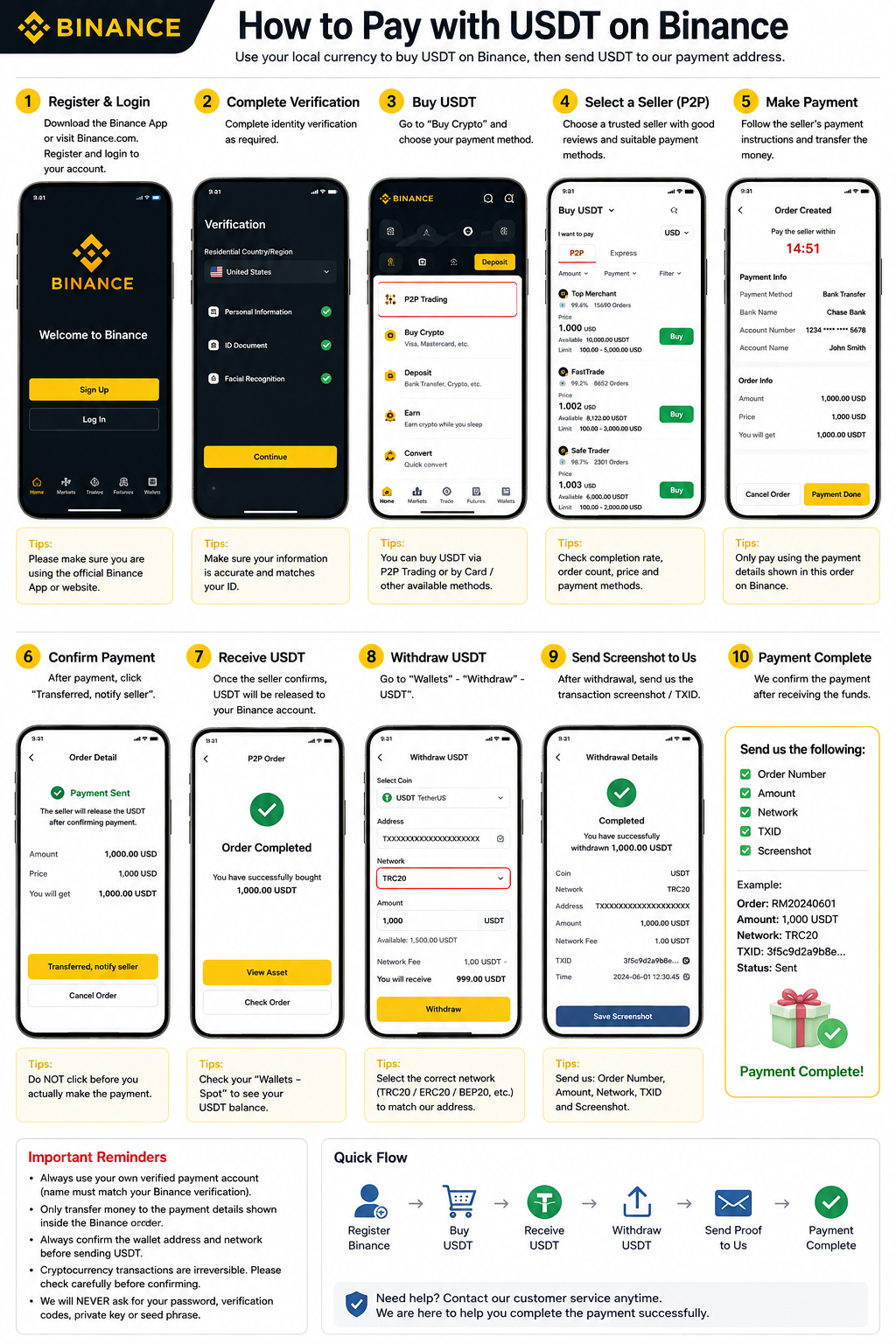
About Binance — Is It Safe to Use?
If this is your first time using cryptocurrency, you may naturally have questions such as:
“What is Binance?”
“Is Binance a legitimate platform?”
“Can I verify this platform independently?”
We completely understand these concerns.
What Is Binance?
Binance is one of the world’s largest cryptocurrency exchanges.
Founded in 2017, Binance provides cryptocurrency services that allow users to buy, sell, hold and transfer digital assets such as:
- USDT (Tether)
- Bitcoin (BTC)
- Ethereum (ETH)
- BNB
- and many other cryptocurrencies
Binance is an independent third-party platform and is not owned, operated or controlled by us.
According to publicly available information, Binance has grown to become the world’s largest cryptocurrency exchange by trading volume.
Why Do We Recommend Binance?
The main reason is simple:
Binance is a large, established and publicly verifiable third-party platform.
Instead of sending your local currency directly to an unfamiliar party, you can use Binance to purchase USDT first.
The process is:
Your Local Currency
↓
Binance
↓
Purchase USDT
↓
USDT Arrives in Your Binance Account
↓
You Confirm Your Order & Payment Details
↓
You Send USDT to Complete Your Payment
The USDT you purchase is first credited to your own Binance account.
You remain in control of your Binance account and decide when to make the final transfer.
Binance Is Independent From Us
This is very important:
Binance is NOT our payment website.
We do not own Binance.
We do not operate Binance.
We cannot access your Binance account.
We cannot control the funds inside your Binance account.
We will also NEVER ask you for:
- Your Binance password
- Your email password
- SMS verification codes
- Google Authenticator codes
- Private keys
- Recovery / seed phrases
Our customer service will only provide the information necessary to complete your payment, such as:
Payment Amount + USDT Address + Blockchain Network
The final transaction is always confirmed by you.
You Don’t Have to Trust Our Description — Verify It Yourself
We strongly encourage first-time customers to research Binance independently before using it.
You can search:
“Binance”
on Google, Wikipedia, major financial/crypto information websites and other independent public sources.
You can review its:
- Company history
- Founders
- Platform history
- Public news coverage
- Regulatory history
- Trading information
- Security information
- Proof of Reserves
This information is publicly available and is not controlled by us.
We would rather have you independently verify the platform before making your payment than simply trust what we tell you.
Proof of Reserves
Binance also publishes a Proof of Reserves (PoR) system designed to provide additional transparency regarding assets held by the platform.
The system uses cryptographic technologies including Merkle Trees and zero-knowledge proofs.
Binance users can independently verify whether their account balances were included in the platform’s reserve verification data.
Proof of Reserves should not be interpreted as a guarantee that any cryptocurrency platform is completely risk-free, but it provides users with an additional method of independently checking information about platform reserves.
Is Binance Completely Risk-Free?
No financial or cryptocurrency platform should be described as completely risk-free.
Like other major cryptocurrency exchanges, Binance has faced regulatory and legal issues in different jurisdictions, and its services and available payment methods vary by country.
We therefore recommend that you:
✓ Research Binance independently
✓ Use only the official Binance website or app
✓ Keep control of your own account
✓ Never share your password or security codes
✓ Confirm the USDT address and network before transferring
✓ Only proceed when you are comfortable with the transaction
Public Information & Independent Verification
You do not need to rely solely on the information provided by us.
You can independently verify Binance through the following public sources:
1. Binance Official Website
Official Binance platform, account registration and product information.
Binance Official Website:
https://www.binance.com/
2. Wikipedia — Binance
Independent public information covering Binance’s history, founders, development and regulatory history.
Wikipedia:
https://en.wikipedia.org/wiki/Binance
3. Google
Search “Binance” on Google to review news, company information and other independent sources.
Google:
https://www.google.com/search?q=Binance
4. Binance Proof of Reserves
Information about Binance’s Proof of Reserves system and how users can independently verify their account inclusion.
Binance Proof of Reserves:
https://www.binance.com/en/proof-of-reserves
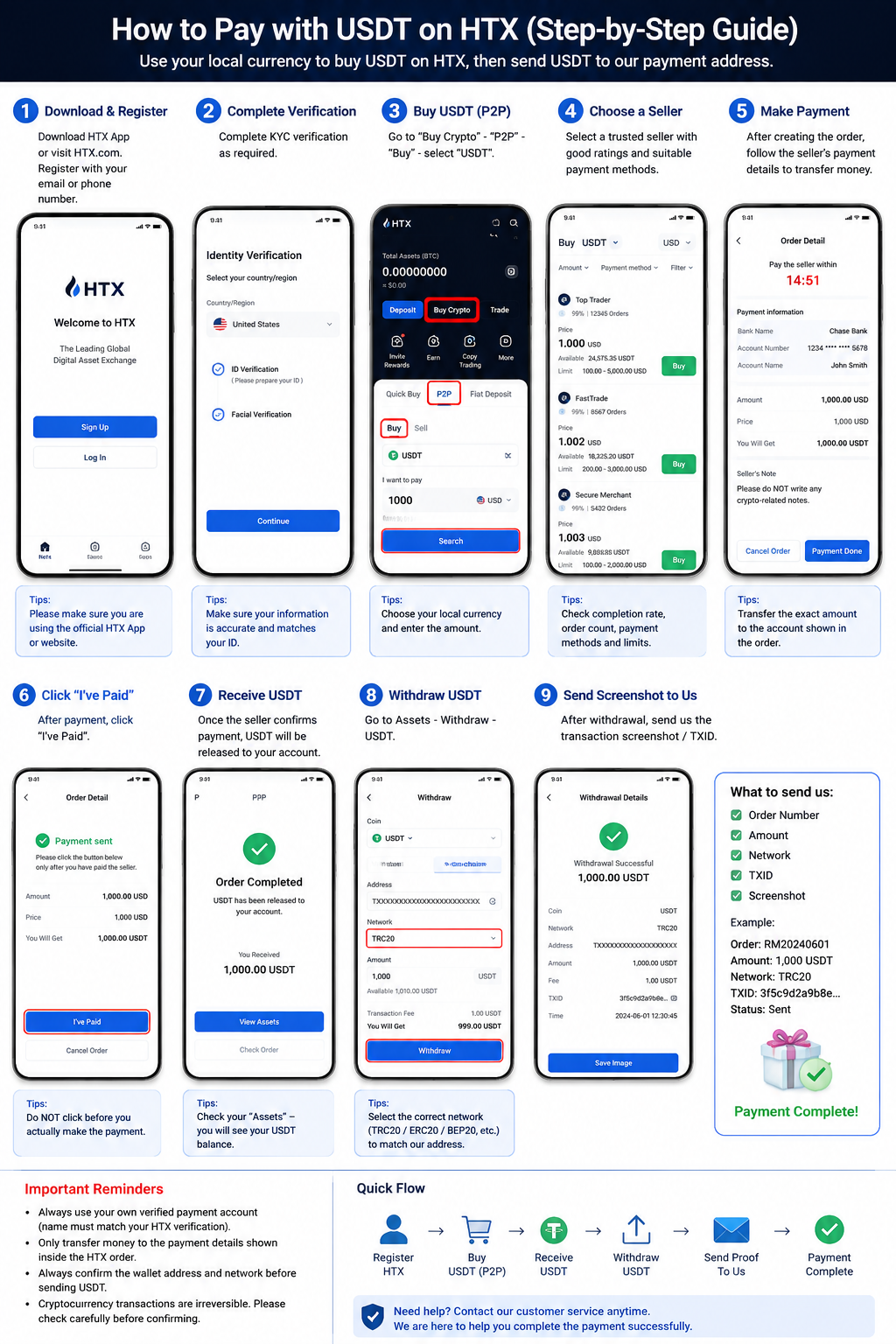
About HTX
If this is your first time using cryptocurrency, you may naturally have questions such as:
“What is HTX?”
“Is HTX a legitimate platform?”
“Can I verify this platform independently?”
We completely understand these concerns.
The most important thing to know is that HTX is not our payment website and is not controlled by us.
It is an independent third-party cryptocurrency exchange with a long public operating history.
What Is HTX?
HTX, formerly known as Huobi, is an international cryptocurrency exchange founded in 2013.
The platform has been operating in the cryptocurrency industry for more than a decade and provides services for buying, selling, holding and transferring digital assets such as:
- USDT (Tether)
- Bitcoin (BTC)
- Ethereum (ETH)
- TRX
- and many other cryptocurrencies
In 2023, Huobi was rebranded as HTX.
Its history, founders, development, ownership changes and other public information can be independently researched through Wikipedia, Google, news organizations and other public sources.
You therefore do not need to rely solely on our description of the platform.
We encourage you to research HTX independently before using it.
Why Do We Recommend HTX?
One of the reasons we recommend HTX in supported regions is that it provides a relatively simple way for customers to convert their local currency into USDT.
Depending on your country and the services available to your account, the process may be:
Your Local Currency
↓
HTX
↓
Purchase USDT
↓
USDT Arrives in Your HTX Account
↓
You Confirm Your Order & Payment Details
↓
You Send USDT to Complete Your Payment
The USDT you purchase is first credited to your own HTX account.
You remain in control of your account and decide when to make the final transfer.
HTX Is Independent From Us
This is very important:
HTX is NOT our payment website.
We do not own HTX.
We do not operate HTX.
We cannot access your HTX account.
We cannot control the funds inside your HTX account.
Our customer service will also NEVER ask you for:
- Your HTX password
- Your email password
- SMS verification codes
- Google Authenticator codes
- Private keys
- Recovery / seed phrases
Your account should always remain under your control.
Our customer service will only provide the information required for your order, such as:
Payment Amount + USDT Address + Blockchain Network
The final transaction is always confirmed by you.
You Don’t Have to Trust Our Description — Verify It Yourself
We strongly encourage first-time customers to independently research HTX before using it.
Simply search:
“HTX”
or:
“Huobi”
on Google, Wikipedia and other independent public sources.
Because HTX was previously known as Huobi, searching both names can help you find its longer operating history.
You can independently review information about its:
- Founding history
- Founders
- Company development
- Rebranding from Huobi to HTX
- Public news coverage
- Regulatory history
- Security history
- Proof of Reserves
- Cryptocurrency services
This information is publicly available and is not controlled by us.
We would rather have you independently verify the platform before making your payment than simply trust what we tell you.
HTX Proof of Reserves
HTX also publishes a Proof of Reserves (PoR) system designed to provide greater transparency regarding assets held by the platform.
HTX states that it aims to maintain user assets on a 1:1 reserve basis and publishes Proof of Reserves reports regularly.
The system uses a Merkle Tree structure that allows users to verify whether their assets were included in the platform’s reserve data.
Users can access HTX’s Proof of Reserves information and independently review the published reserve data.
Proof of Reserves should not be interpreted as a guarantee that any cryptocurrency exchange is completely risk-free.
However, it provides an additional layer of transparency that users can independently examine rather than simply relying on a private company’s statement.
Is HTX Completely Risk-Free?
No.
No cryptocurrency exchange, bank, payment provider or other financial platform should be described as completely risk-free.
Like other major cryptocurrency platforms, HTX has experienced changes in regulation, ownership, branding and service availability over its long operating history.
Its services are also not available in every country.
For this reason, we recommend that you:
✓ Confirm that HTX is available in your country
✓ Research HTX independently
✓ Download HTX only from its official website or official app store listing
✓ Keep control of your own account
✓ Never share passwords or verification codes
✓ Confirm the USDT address and network before transferring
✓ Only proceed when you are comfortable with the transaction
Public Information & Independent Verification
You do not need to rely solely on information provided by us.
You can independently research and verify HTX through the following public sources:
1. HTX Official Website
Official HTX platform and company information.
HTX Official Website:
https://www.htx.com/
2. Wikipedia — HTX
Independent public information covering the history of HTX / Huobi, including its founding, development and rebranding.
Wikipedia — HTX:
https://en.wikipedia.org/wiki/HTX_(cryptocurrency_exchange)
You can also search:
“Huobi Wikipedia”
to review information associated with the platform’s former name.
3. Google
Search:
“HTX Exchange”
or:
“Huobi Exchange”
to independently review news, company information and other public sources.
Google:
https://www.google.com/search?q=HTX+Huobi
4. HTX Proof of Reserves
HTX publishes Proof of Reserves information that allows users to review its reserve data and verification mechanism.
HTX Proof of Reserves:
https://www.htx.com/en-us/proof-of-reserve
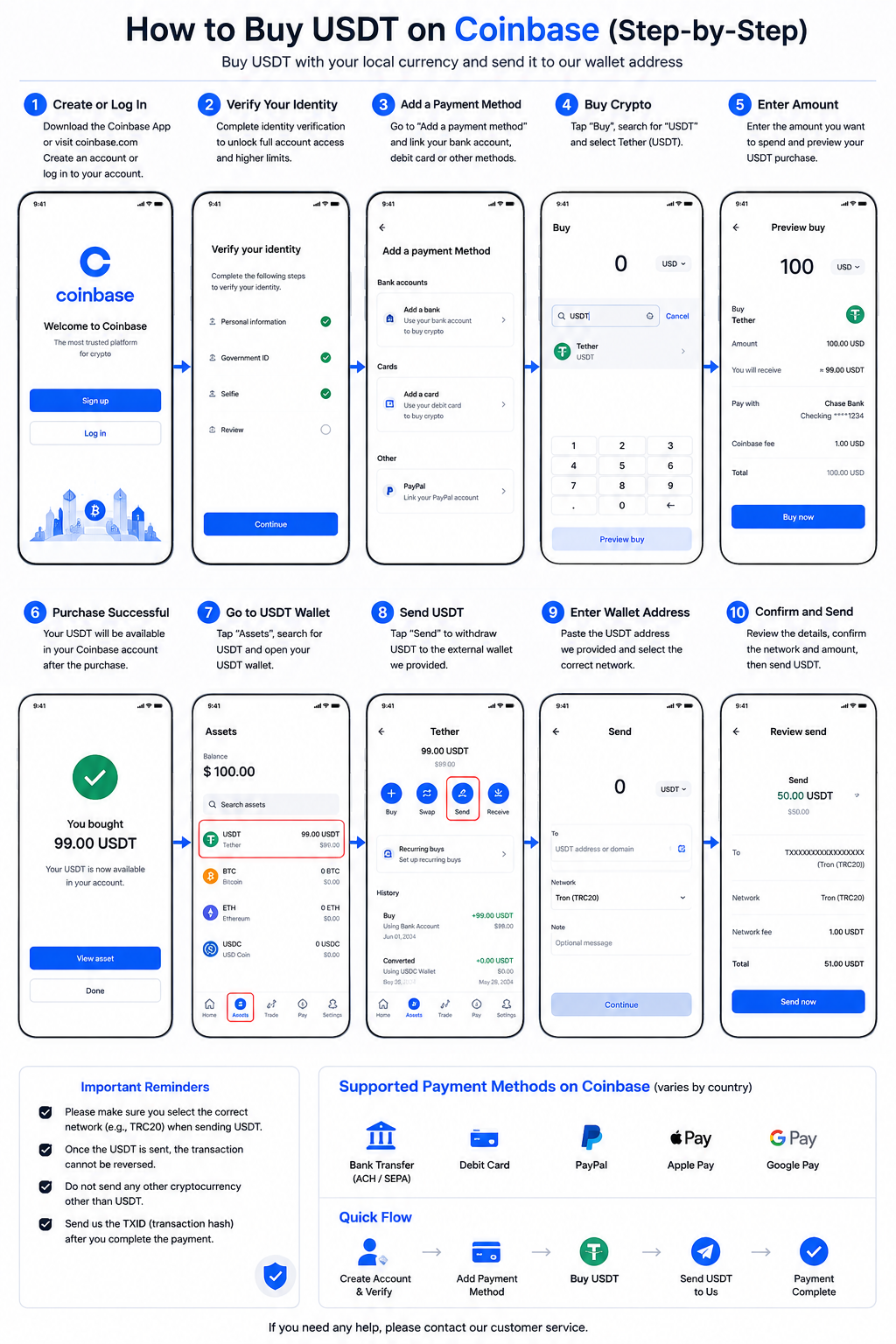
About Coinbase — Security & Trust
If this is your first time using cryptocurrency, you may naturally have questions such as:
“What is Coinbase?”
“Is Coinbase a legitimate platform?”
“Is it safe to purchase USDT through Coinbase?”
These are reasonable questions, and we encourage every customer to research the platform independently before using it.
What Is Coinbase?
Coinbase is one of the largest and most established cryptocurrency platforms in the United States.
The company was founded in 2012 and provides services that allow individuals and institutions to buy, sell, hold and transfer cryptocurrencies.
Unlike an unknown payment website or a payment platform operated by a seller, Coinbase is an independent third-party company.
Most importantly, Coinbase is a publicly traded U.S. company.
Coinbase Global, Inc. became publicly traded on the Nasdaq stock exchange in 2021 under the ticker symbol COIN.
As a U.S. public company, Coinbase is subject to financial reporting requirements, including quarterly financial reporting and annual independent audits.
This provides customers with a level of corporate and financial transparency that can be independently verified.
Why Do We Recommend Coinbase?
For customers in supported countries, especially customers who are new to cryptocurrency, Coinbase can provide a relatively straightforward way to purchase cryptocurrency using familiar payment methods.
Depending on your country and account, available methods may include:
- Bank Transfer
- ACH
- SEPA
- Debit Card
- PayPal or other supported payment methods
Availability varies by country.
The process is simple:
Your Local Currency
↓
Coinbase
↓
Purchase USDT
↓
USDT Arrives in Your Coinbase Account
↓
You Review the Payment Information
↓
You Send the Cryptocurrency Yourself
The cryptocurrency you purchase is first credited to your own Coinbase account.
You remain in control of your account and decide whether and when to make the final transfer.
Coinbase Is Independent From Us
This is very important.
Coinbase is NOT our payment website.
We do not own Coinbase.
We do not operate Coinbase.
We cannot access your Coinbase account.
We cannot control the funds held in your Coinbase account.
Our customer service will NEVER ask you for:
- Your Coinbase password
- Your email password
- Your 2-step verification code
- Your passkey
- Your private key
- Your recovery / seed phrase
Your Coinbase account should always remain under your own control.
Our customer service will only provide the information necessary to complete your payment, such as:
Payment Amount + Cryptocurrency + Receiving Address + Supported Blockchain Network
You should personally review and confirm the transaction before sending.
How Does Coinbase Protect Customer Assets?
Coinbase states that customer cryptocurrency held on Coinbase.com remains the customer’s asset.
Coinbase also states that it holds customer assets 1:1 and does not lend or take action with customer assets without permission.
According to Coinbase, the vast majority of custodied cryptocurrency is strategically stored offline using cold-storage systems, reducing exposure to online attacks.
Coinbase also uses multiple account-security technologies, including:
✓ Two-Factor Authentication (2FA)
✓ Passkeys and Security Keys
✓ Encryption
✓ Biometric / Device Security
✓ Address Allowlisting
✓ Account Security Locks
✓ Cold Storage
Coinbase recommends that customers use strong authentication methods such as passkeys or physical security keys rather than relying solely on SMS verification.
What About Insurance?
Coinbase maintains crime insurance that covers certain losses involving digital assets held across its storage systems, including certain theft and cybersecurity events.
However, it is important to understand what this DOES NOT mean.
Cryptocurrency held on Coinbase is not generally protected by FDIC or SIPC insurance in the same way as money or securities held in a traditional U.S. bank or brokerage account.
Coinbase’s insurance also does not necessarily cover losses caused by:
- A customer giving away their password
- Compromised login credentials
- Phishing
- Sending cryptocurrency to the wrong address
- Selecting the wrong blockchain network
- Transactions voluntarily authorized by the customer
Therefore, account security remains extremely important.
Additional Account Protection
Coinbase provides several security tools designed to help customers protect their accounts.
For example, if suspicious activity is detected or you believe your account has been compromised, Coinbase provides an Account Lock function that can temporarily prevent:
- Cryptocurrency transfers
- Trading
- Account-setting changes
while the account is being secured.
Coinbase also offers additional account-protection features to certain eligible Coinbase One members, although availability, eligibility and coverage limitations vary.
Is Coinbase Completely Risk-Free?
No financial institution, payment platform or cryptocurrency exchange should be described as completely risk-free.
Cryptocurrency transactions also have an important characteristic:
Blockchain transactions are generally irreversible.
Once cryptocurrency has been sent to an external wallet and confirmed on the blockchain, Coinbase normally cannot simply reverse the transaction.
Therefore, before sending any payment, always verify:
✓ Cryptocurrency
✓ Amount
✓ Receiving Address
✓ Blockchain Network
Never send cryptocurrency simply because someone is pressuring you to complete a transaction quickly.
Take your time and verify everything first.
You Don’t Have to Trust Our Description
This is one of the most important points.
We do not expect you to trust Coinbase simply because we recommend it.
Coinbase has been operating since 2012 and is a publicly traded company, so there is a significant amount of independent information available online.
Before using Coinbase, we encourage you to research it yourself.
You can check:
✓ Coinbase Official Website
✓ Coinbase Security Center
✓ Wikipedia
✓ Nasdaq / Public Company Information
✓ Independent News & Financial Sources
You can independently research the company’s history, financial disclosures, security practices, regulatory history and public reputation.
We would rather have you verify the platform yourself and feel comfortable before proceeding with your payment.
Public Information & Independent Verification
Coinbase Official Website
Coinbase Security
https://www.coinbase.com/security
Coinbase Help Center — Account Security
Wikipedia — Coinbase
https://en.wikipedia.org/wiki/Coinbase
Search:
“Coinbase”
https://www.google.com/search?q=Coinbase
You can also search:
“Coinbase Nasdaq COIN”
to independently verify its publicly traded company information.
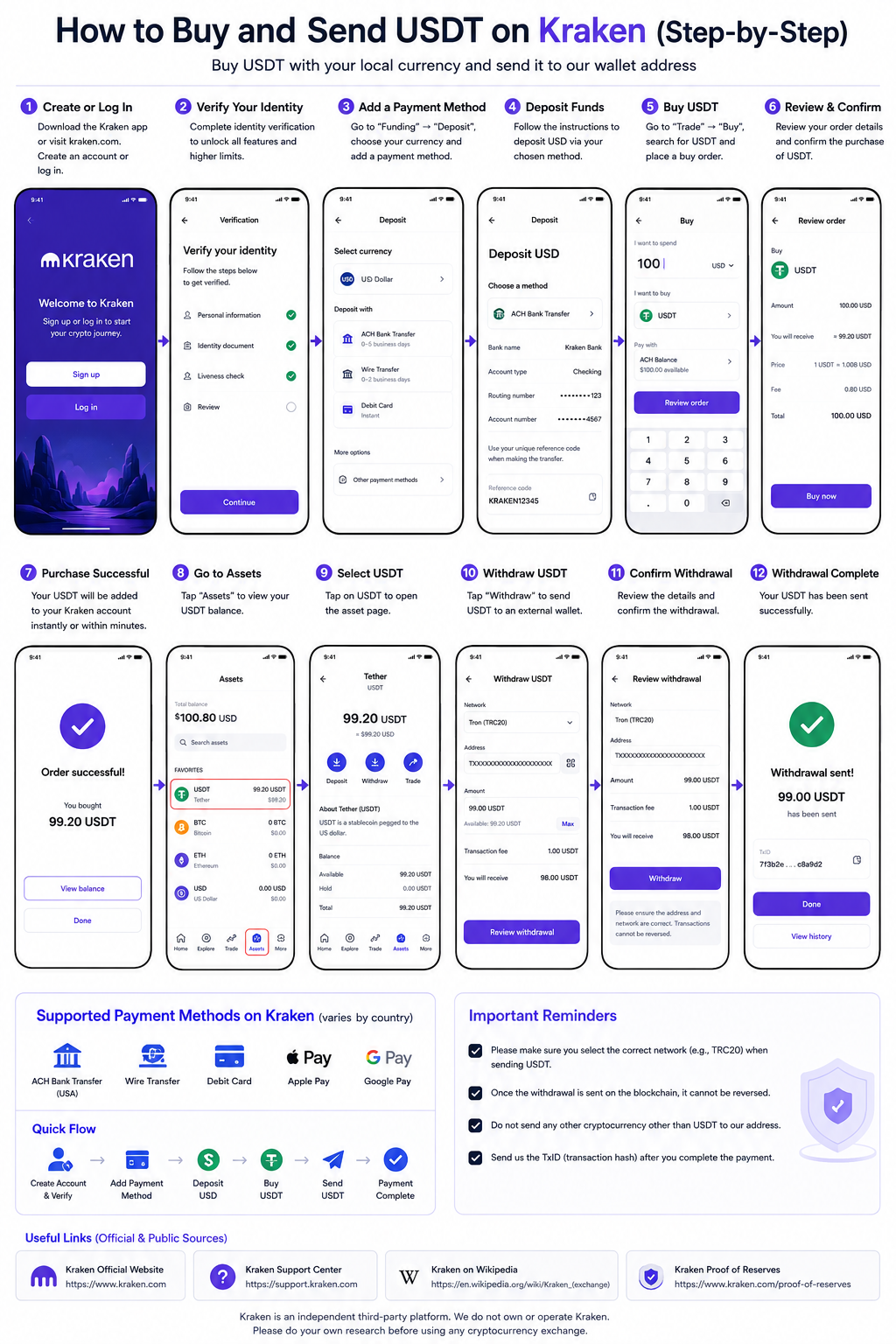
About Kraken — Security & Trust
If this is your first time using cryptocurrency, you may naturally have questions such as:
“What is Kraken?”
“Is Kraken a legitimate cryptocurrency platform?”
“Is it safe to purchase and send USDT through Kraken?”
These are reasonable questions.
We encourage every customer to independently research any financial or cryptocurrency platform before depositing money or purchasing cryptocurrency.
What Is Kraken?
Kraken is one of the longest-established major cryptocurrency exchanges in the world.
Kraken was founded in 2011 and launched its cryptocurrency trading platform in 2013.
The platform provides services that allow customers to buy, sell, hold and transfer digital assets such as:
- USDT
- USDC
- Bitcoin (BTC)
- Ethereum (ETH)
- and many other cryptocurrencies
Kraken operates independently from us.
It is not a payment website created or controlled by our company.
Kraken’s history, regulatory information, security practices and company background can all be independently researched through public sources.
Why Do We Recommend Kraken?
For customers in supported countries, Kraken provides a relatively straightforward way to purchase cryptocurrency using traditional payment methods.
Depending on your country and account, available funding methods may include:
- Bank Transfer
- ACH
- SEPA
- Wire Transfer
- Debit / Credit Card
- Apple Pay / Google Pay
- Other locally supported methods
Availability varies by country.
The basic process is:
Your Local Currency
↓
Kraken
↓
Purchase USDT
↓
USDT Arrives in Your Kraken Account
↓
You Review the Payment Information
↓
You Send USDT Yourself
Your cryptocurrency is first credited to your own Kraken account.
You remain in control of your account and decide when to make the final transfer.
Kraken Is Independent From Us
This is very important.
Kraken is NOT our payment website.
We do not own Kraken.
We do not operate Kraken.
We cannot access your Kraken account.
We cannot control the funds inside your Kraken account.
Our customer service will NEVER ask you for:
- Your Kraken password
- Your email password
- Your 2FA code
- Your Passkey
- Your Master Key
- Your private key
- Your recovery / seed phrase
Your Kraken account should always remain under your own control.
Our customer service will only provide the information required to complete your order, such as:
Payment Amount + Cryptocurrency + Receiving Address + Supported Blockchain Network
The final transaction is always reviewed and confirmed by you.
How Does Kraken Protect Customer Accounts?
Kraken uses multiple layers of security designed to protect customer accounts, cryptocurrency and personal information.
These include:
✓ Two-Factor Authentication (2FA)
✓ Passkeys / FIDO2 Security Keys
✓ Global Settings Lock (GSL)
✓ Device Management
✓ Data Encryption
✓ Cold and Hot Wallet Security Infrastructure
✓ Continuous Security Monitoring
✓ Bug Bounty Program
Kraken recommends enabling strong authentication methods such as Passkeys and 2FA to help prevent unauthorized account access.
ISO 27001 & SOC 2
Kraken has obtained ISO/IEC 27001:2022 certification for its information-security management system.
ISO/IEC 27001 is an internationally recognized standard for managing information-security risks.
Kraken has also completed a SOC 2, Type 1 examination.
These certifications and examinations do not mean that a platform can never experience a security incident.
However, they provide independent evidence that Kraken has established formal information-security controls and processes.
Proof of Reserves
One of Kraken’s most important transparency features is its Proof of Reserves (PoR) program.
Kraken was an early adopter of Proof of Reserves and has been conducting this type of verification for many years.
Kraken periodically works with an independent accounting firm to verify that covered customer cryptocurrency balances are backed by assets controlled by Kraken at the time of the verification.
The process uses cryptographic verification, including Merkle Tree technology.
This allows eligible customers to independently verify that their own balances were included in the Proof of Reserves snapshot without publicly revealing their personal account information.
1:1+ Proof of Reserves
Kraken’s Proof of Reserves does more than simply publish cryptocurrency wallet addresses.
The verification considers covered customer liabilities and compares them with assets controlled by Kraken.
For example, Kraken’s Proof of Reserves dated December 31, 2025 reported that covered client assets were backed 1:1 or greater.
The report included major cryptocurrencies such as:
BTC
ETH
SOL
USDT
USDC
XRP
ADA
Most importantly, customers can independently verify whether their eligible account balances were included in the Proof of Reserves snapshot.
Proof of Reserves is not a guarantee that a cryptocurrency exchange can never experience financial or operational problems.
However, it provides an additional level of transparency that customers can independently verify.
Regulatory Information
Kraken operates through different regulated entities depending on the customer’s jurisdiction.
For example, Kraken states that its U.S. entity maintains registration as a Money Services Business (MSB) with FinCEN.
Kraken Financial also operates as a Wyoming-chartered Special Purpose Depository Institution (SPDI) for certain eligible custody services.
Kraken additionally publishes jurisdiction-specific licensing and regulatory information for regions including:
- United States
- Canada
- United Kingdom
- European Economic Area
- Australia
The exact Kraken entity and services available to you depend on your country of residence.
Are Kraken Cryptocurrency Balances Insured?
This point is important.
Cryptocurrency held in a standard Kraken exchange account should NOT be assumed to have the same government deposit insurance protection as money held in a traditional bank account.
Kraken explicitly states that digital assets and Kraken accounts are generally not protected by:
FDIC
or
SIPC
in the United States, or equivalent deposit-protection organizations elsewhere.
This is why we do not describe Kraken — or any cryptocurrency exchange — as completely risk-free.
Is Kraken Completely Risk-Free?
No.
No cryptocurrency exchange, bank or payment platform should be described as completely risk-free.
Customers remain responsible for protecting their own account credentials.
Cryptocurrency transactions also have an important characteristic:
Blockchain transactions are generally irreversible.
If cryptocurrency is sent to the wrong address or through an incompatible blockchain network, recovering the funds may be difficult or impossible.
Before making a payment, always verify:
✓ Cryptocurrency
✓ Amount
✓ Receiving Address
✓ Blockchain Network
Never make a cryptocurrency transfer simply because someone is pressuring you to complete the transaction quickly.
Take your time and verify the information first.
You Don’t Have to Trust Our Description
This is one of the most important points.
We do not expect you to use Kraken simply because we recommend it.
Kraken has been operating for more than a decade and has a substantial amount of publicly available information.
Before using Kraken, we encourage you to research it independently.
You can check:
✓ Kraken Official Website
✓ Kraken Security Center
✓ Kraken Proof of Reserves
✓ Kraken Regulatory Information
✓ Wikipedia
✓ Independent financial and news sources
Research the platform yourself and only proceed when you are comfortable using it.
Public Information & Independent Verification
1. Kraken Official Website
Official Kraken website and account platform.
2. Kraken Security
https://www.kraken.com/features/security
Information about Kraken’s security infrastructure, Proof of Reserves, cold-storage architecture and information-security controls.
3. Kraken Proof of Reserves
https://www.kraken.com/proof-of-reserves
Learn how Kraken’s Proof of Reserves works and how customers can independently verify eligible balances.
4. Kraken Regulatory & Licensing Information
https://support.kraken.com/articles/where-is-kraken-licensed-or-regulated
Information about Kraken’s registrations and regulatory status in different countries.
5. Wikipedia — Kraken
https://en.wikipedia.org/wiki/Kraken_(company)
Independent public information about Kraken’s history and development.
6. Google
Search:
“Kraken cryptocurrency exchange”
https://www.google.com/search?q=Kraken+cryptocurrency+exchange
You can independently review news, company information, regulatory history and other third-party sources.